The changing F-Gas landscape across Great Britain and the EU has made cooling-system manufacturers reflect on the refrigerants they should use in their next-generation enclosure cooling systems.
There are several options to choose from, prime among them being R290 (Propane) and R-1234yf, not forgetting R513A which is still likely play a role where flammability is not allowed.
The Global Warming Potential (GWP) varies for each option and will inevitably influences that decision, particularly as regulators continue to reduce the use and availability of higher-GWP refrigerants.
The EU and Great Britain are both pursuing HFC phase-downs, although each is now operating under a different regulatory regime.
Within the EU, the Regulation (EU) 2024/573 introduces increasingly tight restrictions on fluorinated greenhouse gases, including GWP limits for specified categories of new cooling equipment.
Great Britain (GB) currently retains its own F-Gas legislation and HFC phase-down schedule covering England, Scotland and Wales (Northern Ireland complies with EU regulations). The UK Government confirmed in May 2026 that it would retain its existing phase-down step scheduled for January 2027 while it considers longer-term reform.
These regulatory changes explain why GWP matters, although the refrigerant still has to work effectively within the finished cooling unit.
Why Rittal selected R-1234yf for thermoelectric cooling units
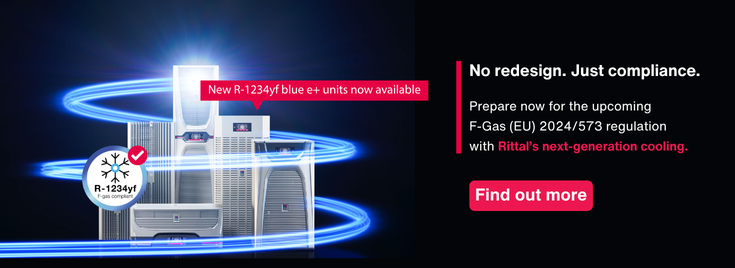
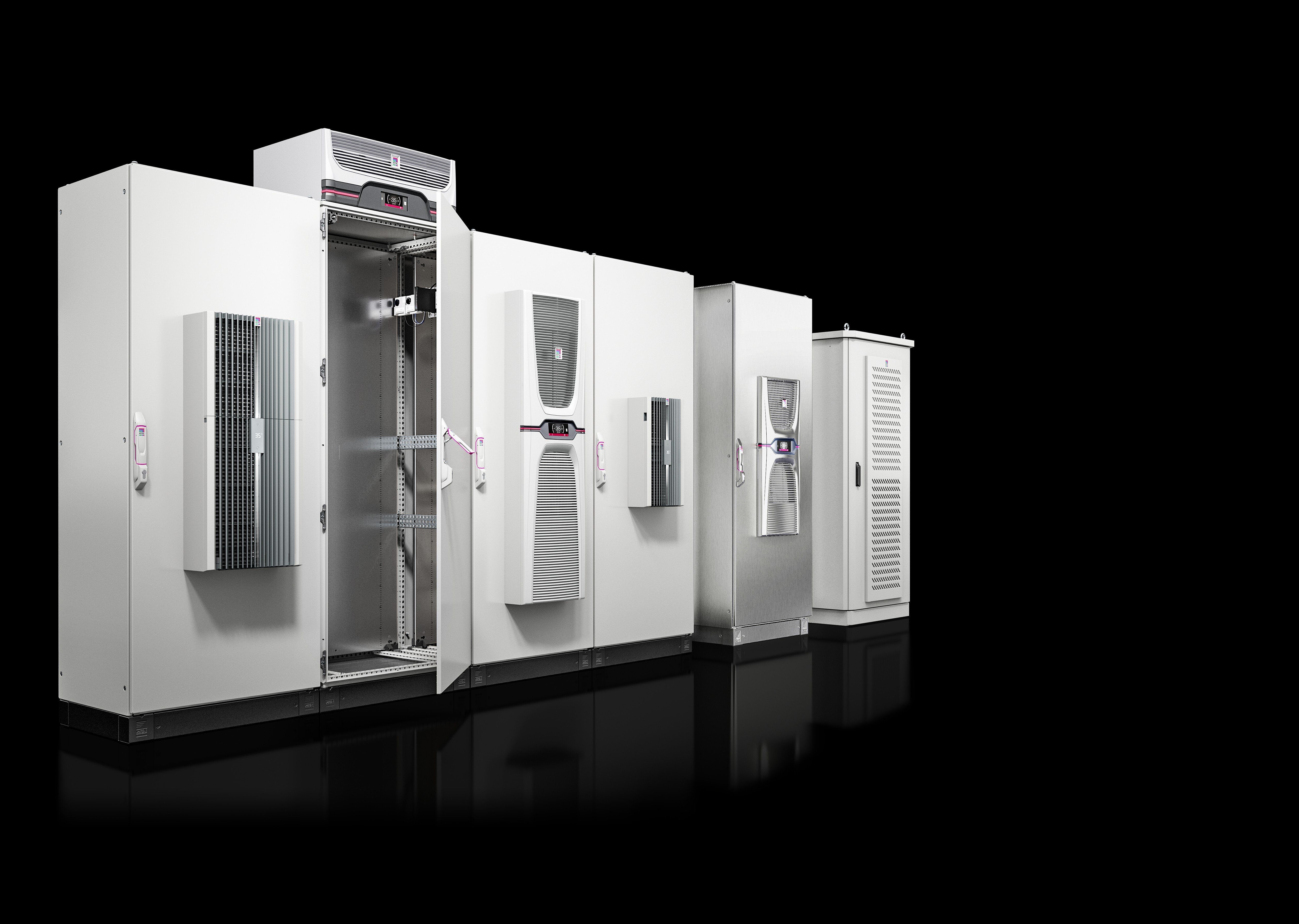
We have chosen to use R-1234yf within our award-winning Blue e+ and Blue e+ S cooling-unit units following our assessment of the refrigerant's environmental impact and its effectiveness/suitability for industrial enclosure cooling.
R-1234yf has a GWP of 4, which places it comfortably below the GWP 150 threshold that applies to relevant categories of new cooling equipment under the EU regulation from January 2027.
The refrigerant also carries an A2L safety classification under ASHRAE 34 and ISO 817, meaning it has lower toxicity with mild flammability (our R-1234yf cooling units comply with EN/IEC 60335-2-40 safety requirements for these systems).
Despite changing the refrigerant, we are still able to offer the renowned operating principles behind our Blue e+ technology. Our R-1234yf Blue e+ units continue to employ a combination of compressor cooling with heat-pipe operation, allowing the units to reduce their compressor use when ambient conditions permit for maximum energy efficiency with optimum cooling.
This principle is a key consideration, because a refrigerant’s GWP describes its potential climate impact in the event of a release. But that’s not the only climate-related issue associated with enclosure cooling. The electricity consumed throughout a cooling unit's working life also has an environmental impact, as well as an operating cost.
Does R-513A still have a role in certain applications?
R-1234yf will not suit every installation, particularly in situations where site-specific safety requirements would prevent the use of an A2L refrigerant
R513A remains widely used in existing UK control-cabinet cooling systems, with its A1 classification providing lower toxicity and no flame propagation under standard test conditions, however, its GWP is around 631. This means that, from 2027, its use in new equipment will depend on both the market (whether its customer site will place it under EU or GB regulations) and equipment category.
We have a portfolio of cooling products that use R-513A for sites where flammability is not permitted. However, any panel builders or system integrators who are relying on this exemption will need proof that the installation meets regulatory conditions.
Customers will need to provide a site-specific risk assessment to clarify why the safety requirements at an operating site would prevent the use of a lower-GWP alternative.
A refrigerant decision that extends beyond GWP
R-290, or propane, offers another route towards very low-GWP cooling and carries a lower GWP than R-1234yf.
However, it its A3 classification means manufacturers must account for its higher flammability when designing their cooling units.
Of itself, that flammability does not necessarily make R-290 an unsuitable refrigerant, but the unit’s design does need to be factored in within the context of the operating site.
Our choice of R-1234yf is based on its combination of very low GWP and A2L classification, which reduce the need to treat refrigerant selection as an isolated environmental calculation or regulatory restriction. Instead, customers can simply focus on how the complete cooling unit would manage the thermal demands required by the project, understanding that the energy demands for our cooling units has also been optimised.
FAQs